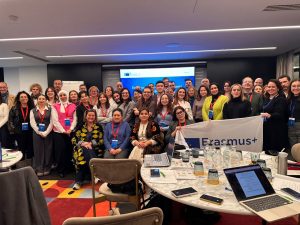
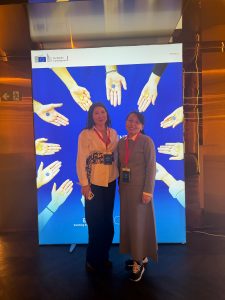
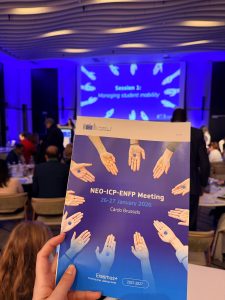
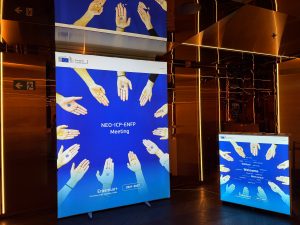
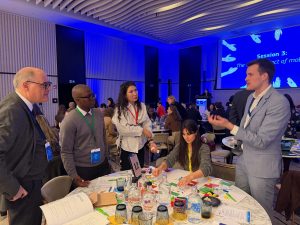
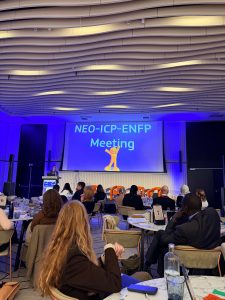
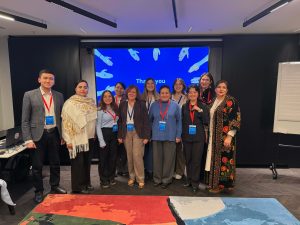
The NEO-ICP-ENFP Meeting 2026 took place on 26–27 January 2026 in Brussels, bringing together representatives of National Erasmus+ Offices (NEOs), Erasmus+ National Focal Points (ENFPs), International Contact Points (ICPs), European Commission services, and higher education stakeholders from across the world. The meeting served as a key platform to discuss the future of international mobility, policy developments, and the evolving role of Erasmus+ beyond 2026.
Day 1 – International Mobility Seminar: Management, Impact, and Global Perspectives
The first day opened with an International Mobility Seminar, chaired by the Head of Unit for International Capacity Building at EACEA. Welcome remarks by senior representatives of EACEA and the European Commission set the scene for in-depth discussions on the role of mobility in strengthening higher education systems and international cooperation.
Panel discussions throughout the day focused on the practical and strategic aspects of managing student and staff mobility under Erasmus+. Experts and practitioners from Europe, Africa, Latin America, and partner countries shared experiences on:
-
supporting students before, during, and after mobility,
-
ensuring quality, inclusiveness, and recognition,
-
using staff mobility as a tool for institutional development and capacity building.
Interactive table discussions allowed participants, including NEO representatives, to exchange practical solutions to common challenges faced in international mobility management.
A dedicated Sandbox Game session introduced an innovative, interactive approach to understanding international mobility management. Participants worked in mixed regional groups to simulate real-life decision-making scenarios related to mobility planning, implementation, and problem-solving.
The Sandbox Game allowed NEOs and other stakeholders to: test strategic choices in a risk-free environment, better understand the perspectives of different actors involved in mobility, and reflect on how policy decisions translate into practical outcomes.
This hands-on activity proved particularly valuable for NEOs from Central Asia, as it offered practical insights that can be applied when advising institutions and stakeholders on Erasmus+ mobility opportunities.
A dedicated panel addressed the broader impact of Erasmus+ mobility, highlighting how international exchanges contribute not only to individual learning outcomes, but also to institutional reform, internationalisation strategies, and long-term cooperation between regions. Capacity Building in Higher Education (CBHE) projects were presented as concrete examples of sustainable impact, particularly relevant for Central Asian higher education institutions.
The final panel of the day explored mobility frameworks outside Erasmus+, offering insights into complementary programmes and international cooperation instruments. This discussion was particularly useful for NEOs, as it provided a broader context for advising institutions and students interested in international opportunities.
The day concluded with a networking session, encouraging cross-regional dialogue and the exchange of experiences among NEOs, ENFPs, and partner organisations.
Day 2 – Policy Developments, Regional Cooperation, and the NEO Focus
The second day focused on policy developments, programme implementation, and targeted sessions for NEOs, ENFPs, and ICPs.
Representatives of the European Commission presented recent and upcoming policy developments influencing Erasmus+, including international cooperation priorities, regional strategies, and global mobility trends. Particular attention was paid to regulatory and visa-related issues affecting effective mobility to Europe.
A central element of Day 2 was the NEO meeting, which addressed the evolving role of National Erasmus+ Offices beyond 2026. Key discussion points included:
-
future perspectives and positioning of NEOs,
-
effective NEO grant management and reporting,
-
timelines and requirements for the upcoming NEO Invitation to Submit,
-
improved use of SPHERE resources and cooperation with HEREs,
-
and communication strategies to enhance the visibility of Erasmus+ initiatives.
During the NEO regional workshops, representatives from Central Asia engaged in focused discussions on shared priorities, challenges, and good practices. Topics included stakeholder engagement, outreach strategies, and alignment of Erasmus+ actions with national higher education reforms.
The Central Asia session underlined the importance of regional cooperation and coordinated approaches to strengthening the impact of Erasmus+ across the region.
The NEO-ICP-ENFP Meeting 2026 reaffirmed the central role of international mobility in Erasmus+ and highlighted the importance of National Erasmus+ Offices in partner countries. For Central Asia, including Kyrgyzstan, the meeting provided valuable policy insights, practical tools, and opportunities for regional exchange.
The National Erasmus+ Office in Kyrgyzstan will build on the outcomes of the meeting to further support higher education institutions, strengthen cooperation with national stakeholders, and contribute to the sustainable internationalisation of higher education in the country.
Agenda: NEO-ICP-ENFP meeting 2026_Agenda_FIINAL