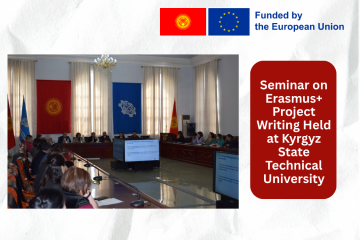
Following the Technical Assistance Mission (TAM) seminar “Future Skills: How Universities Can Prepare for Jobs That Don’t Yet Exist”, held on 12 December 2025, a comprehensive follow-up document has been developed to support Kyrgyzstani higher education institutions (HEIs) in translating seminar insights into institutional action.
The roadmap responds to rapid changes driven by digitalization, AI, the green transition, and social uncertainty. It emphasizes a shift from traditional, content-heavy education models toward systematic development of future skills – transversal, meta, and green competencies that enable graduates to adapt, innovate, and learn continuously throughout life.
Alignment with Global Frameworks
The roadmap is aligned with leading international policy frameworks, including:
- UNESCO and its Futures of Education agenda, which calls for education that goes beyond factual knowledge to build capacity for uncertain futures;
- OECD and the Learning Compass 2030, highlighting learner agency, adaptability, and transformative competencies;
- European Union policies such as the European Skills Agenda, Key Competences for Lifelong Learning, DigCompEdu, and the European approach to micro-credentials.
These frameworks informed the seminar discussions and now underpin the proposed institutional reforms.
Key Trends Identified
Building on the four thematic sessions of the TAM seminar, the document highlights several key trends:
- Growing demand for transversal, meta-cognitive, and green skills across all disciplines;
- The need for competency-based, flexible, and regularly updated curricula;
- Stronger work-based learning and structured employer partnerships;
- Teaching and assessment innovation through digital tools, AI, project-based and challenge-based learning;
- Expansion of lifelong learning through modular programs and micro-credentials;
- Continuous faculty development and whole-of-institution capacity building.
The Phased Roadmap (2026–2028)
The roadmap proposes a three-phase approach for institutional transformation:
2026 – Foundation Building and Pilots
HEIs are encouraged to adopt a Future Skills Integration Strategy, audit existing curricula, launch pilot curriculum reforms, initiate employer advisory boards, test innovative pedagogies, and explore micro-credentials. Faculty awareness-raising and initial training are central at this stage.
2027 – Scaling and Integration
Successful pilots are scaled across faculties. Most study programs integrate future skills learning outcomes, employer partnerships are formalized, internships and mentorship schemes expand, micro-credentials are institutionalized, and faculty development becomes systematic and incentivized.
2028 – Institutionalization and Continuous Innovation
Future skills integration becomes embedded in academic policy, quality assurance, and institutional culture. All programs align with agreed competencies, micro-credentials and lifelong learning pathways mature, employer collaboration is sustained, and HEIs position themselves as innovation hubs serving society and the economy.
Purpose and Impact
This follow-up document translates the outcomes of the December 2025 TAM seminar into a clear, actionable roadmap with milestones, responsible units, and indicators. Its goal is to help Kyrgyzstani HEIs:
- Equip graduates with flexible, future-proof competencies;
- Strengthen links between education, labor markets, and innovation ecosystems;
- Align national higher education reforms with global standards and the European Higher Education Area.
By implementing this roadmap, universities in Kyrgyzstan can reinforce their third mission, contribute to sustainable development, and ensure that higher education remains relevant in a rapidly changing world.